
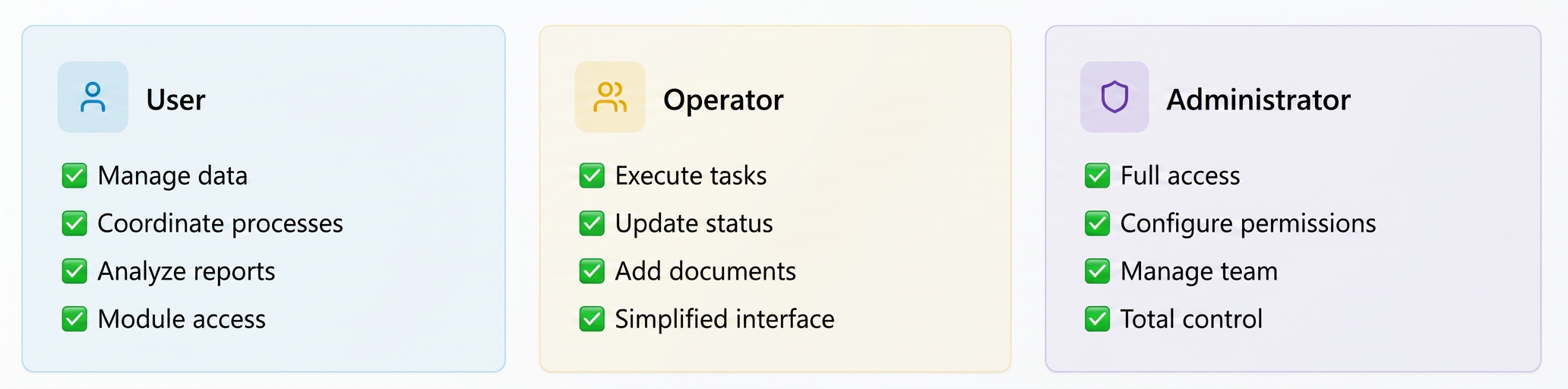
Within the iFlows platform, the roles of user and operator define the level of interaction with the system and the type of responsibilities of each person in the company.
1. What is a User?
Users are the people who actively manage information in the platform and coordinate internal processes.
They can:
- add and edit customers, products, orders, documents or invoices;
- track stocks, deliveries, payments and team performance;
- analyze reports, performance indicators and workflows;
- access the platform menu.
A user's access is personalized based on their role.
👉 In short: the user is the one who creates, coordinates and controls information in the system, depending on their responsibilities.
2. What is an Operator?
Operators are the people who work directly in production, logistics, service or execution.
They do not administer the system, but use it to manage their own tasks within the workflow.
Operators:
- see only their stages and tasks within the flow;
- can update the status ("In progress", "Completed", "On break");
- can add notes, photos or documents relevant to each stage and order;
- cannot create orders, customers, documents or invoices;
- cannot see the platform menu.
3. How does the access hierarchy work in iFlows?
iFlows allows granular configuration of permissions:
- each account has a main role (operator / user / administrator);
- within each USER role, access levels can be set (view, edit, delete, export, etc. – for each section of the platform);
- access can be defined based on department or position.
Thus:
- The Operator has access only to their own tasks.
- The User has access to the modules specific to their activity.
- The Administrator has full access and sets the rules for the others.
4. Why does an operator cost only 10% of a user?
Because the iFlows philosophy is to facilitate the involvement of all employees in the company's digital ecosystem.
In most organizations, there is a perception that ERP/CRM software is used only by office staff — but the operational reality shows otherwise.
In the execution of an order/project, operators are those who generate the most real information about the status of projects, orders and execution.
They are the direct point of contact with the reality of the process — and when they update tasks in real time, management has a complete, correct and up-to-date picture.
Therefore:
- iFlows encourages complete digitalization of the team, not just the offices;
- the operator license is designed to cost only 10% of a user's value, to make it possible to include everyone in the platform;
- the interface for operators is intuitive, clear and simplified, designed even for people without computer experience.
🎯 The goal is not just to automate processes, but complete integration of the entire team into a single system — from the office to the factory floor.
🧭 Conclusion
The difference between user and operator reflects not only the level of access, but also the iFlows work philosophy:
- The Operator – executes tasks and provides real data from the field.
- The User – creates orders/tasks/projects, administers, coordinates and analyzes processes.
Through this model, iFlows makes the complete digitalization of the company possible, without cost or technical skill barriers.