
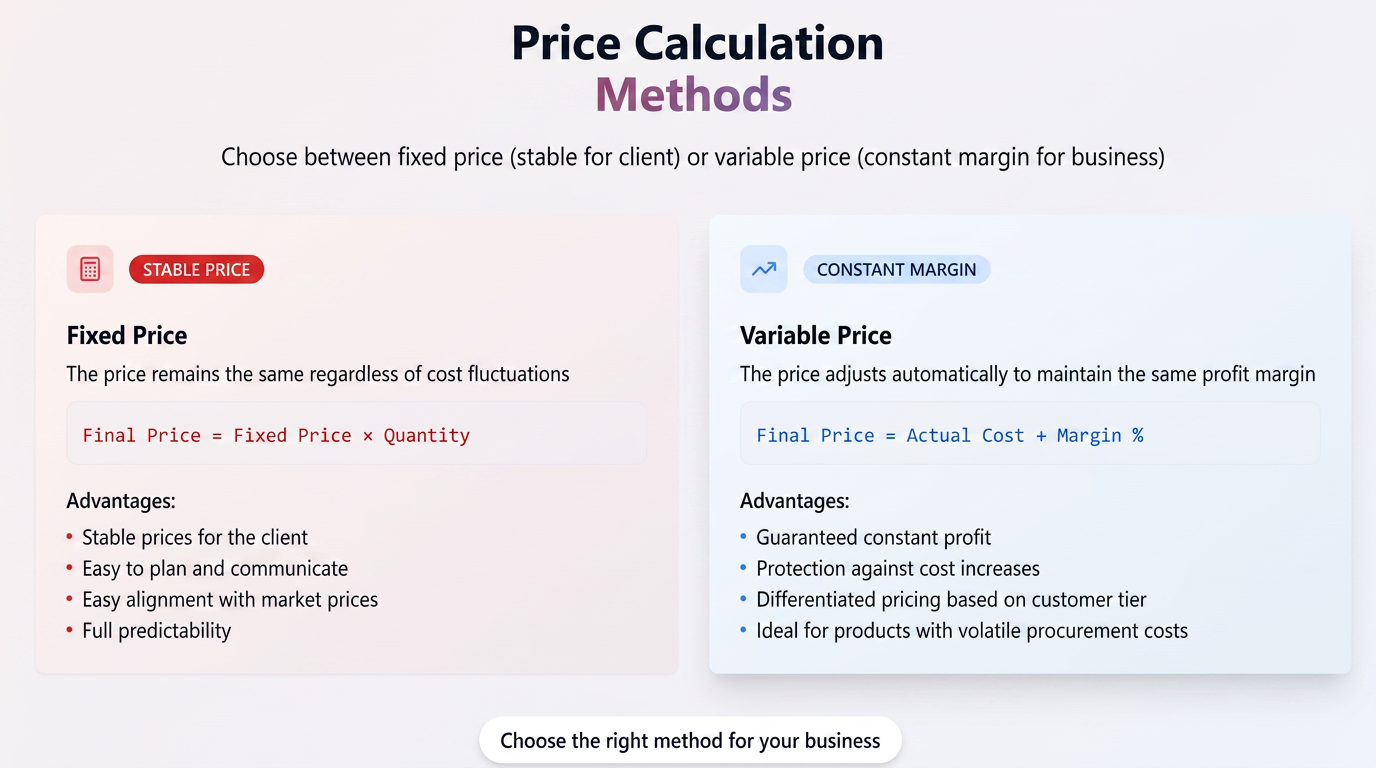
In the platform, the final price of a product can be calculated using two main methods, each having specific advantages depending on the business strategy, product type, and customer relationship. This guide explains the two options in detail: Fixed Sales Price and Variable Price (Cost + Markup).
Fundamental Concepts
- Cost vs. Price:
- Cost: Represents the total amount of money invested to produce or acquire a good (raw material cost, processing cost, depreciation, etc.).
- Price: Represents the amount of money the end customer pays to acquire that good.
- Product Types:
- Raw Material: The basic element that enters production (e.g., wood, metal, paint).
- Simple Products: Those that do not require processing.
- Services
- Super Product / Finished Product: The final result obtained by combining raw material with one or more processing steps.
Additional term: Equipment / Processing: The technological action applied to the raw material (e.g., CNC cutting, welding, painting). Each process has an associated cost.
- Equipment Processing Cost:
The cost generated by equipment consists of Fixed Cost (depreciation, rent, salaries) and Variable Cost (consumables, electricity). The system calculates a final processing cost (e.g., 3 euros / square meter).- Work Profile: Allows adjusting this base cost according to the complexity of the work. For example:
- Standard Profile (100%): Cost remains 3 euros/sqm.
- Special Model Profile (300%): Cost becomes 9 euros/sqm.
- Low Quality Profile (50%): Cost is reduced to 1.5 euros/sqm.
- Work Profile: Allows adjusting this base cost according to the complexity of the work. For example:
2. Method 1: Calculation Based on FIXED Sales Price
This method is ideal for situations where you want a stable sales price that does not fluctuate with the acquisition cost of raw materials.
Calculation formula:
Final Price = (Fixed Raw Material Sales Price/UM + Fixed Processing Sales Price/UM) x Quantity
(UM = Unit of Measure, e.g., piece, square meter)
Where is it configured?
- For Raw Material: In the product page, in the Fixed Sales Price field.
- For Equipment: In the equipment page, at the corresponding Work Profile, in the Fixed Sales Price field.
Practical example:
- Order: A beech wood countertop, size 1x1 sqm, processed with the "Special Model" profile.
- Fixed Price Configuration:
- Raw Material (Beech Wood): Set Fixed Sales Price = 20 euro/sqm.
- CNC Equipment ("Special Model" Profile): Set Fixed Sales Price = 8 euro/sqm.
- Calculation for 1 sqm:
- The system adds the fixed prices per unit of measure: 20 euro/sqm (wood) + 8 euro/sqm (processing) = 28 euro/sqm.
- Final Price = 28 euro.
Advantage: The price is predictable and easy to communicate to the customer, regardless of internal costs.
Important: Even if the sales price is fixed, the system will calculate the actual costs to provide you with accurate profitability reports.
3. Method 2: Calculation Based on VARIABLE PRICE (Cost + Markup)
This method is perfect for ensuring a constant profit margin. The sales price adjusts dynamically based on the acquisition cost of raw materials and the processing cost.
Calculation formula:
Final Price = (Total Raw Material Cost + Total Processing Cost) + Markup %
Where is it configured?
- For Raw Material: The Acquisition Cost is used (e.g., 10 euro/sqm). The markup is defined as a percentage based on the customer category (e.g., Small Business Markup = 200%).
- For Equipment: The final Cost calculated by the system for the Work Profile is used (e.g., 9 euro/sqm for "Special Model").
Practical example:
- Order: A beech wood countertop, size 1x1 sqm, processed with the "Special Model" profile, for a customer in the "Small Business" category.
- Cost Identification:
- Raw Material (Beech Wood): Acquisition Cost = 10 euro/sqm.
- CNC Equipment ("Special Model" Profile): Processing Cost = 9 euro/sqm.
- Markup: For "Small Business" customers, the markup is set to 200%.
- Calculation for 1 sqm:
- Total Cost: 10 euro (wood) + 9 euro (processing) = 19 euro.
- Markup Calculation: 19 euro x 200% = 38 euro.
- Final Price: 19 euro (Cost) + 38 euro (Markup) = 57 euro.
Advantage: Protects the profit margin against cost fluctuations and allows for a differentiated pricing strategy by customer categories.
Comparative Summary
| Feature | FIXED PRICE Method | VARIABLE PRICE Method (Cost + Markup) |
| Calculation Basis | Predefined sales prices. | Real costs (acquisition + processing). |
| Price Stability | Very stable. Does not change if costs change. | Fluctuates with costs. |
| Margin Stability | Profit margin varies if costs change. | Profit margin (%) is constant. |
| Ideal for | Situations where you want to align with competitors' prices and these are known. | Products with volatile acquisition costs, pricing strategies across customer segments. |
| Simplified Formula | Fixed material price + Fixed processing price | (Raw material cost + Processing cost) + Markup % |
Choosing the correct price calculation method depends entirely on your business model.
Note: Regardless of the chosen calculation method – whether you use a Fixed Sales Price or a Variable Price based on cost and markup – the final price generated by the system can be edited directly in the quote or order page. The automatically calculated price serves as a correct and fast starting point, but you always have the final control.